CIA (Module)
Note
Required role: everyone who can open the module settings reads the tab. The requirements can be edited by developers, company security managers, and managers and compliance managers who are the module's default manager (or if none is set). Import is for developers, company security managers and default managers. Saving is also checked on the server, which accepts account admins, managers and compliance managers. The risk assessment scheme needs the risks license; account admins, managers and compliance managers edit it.
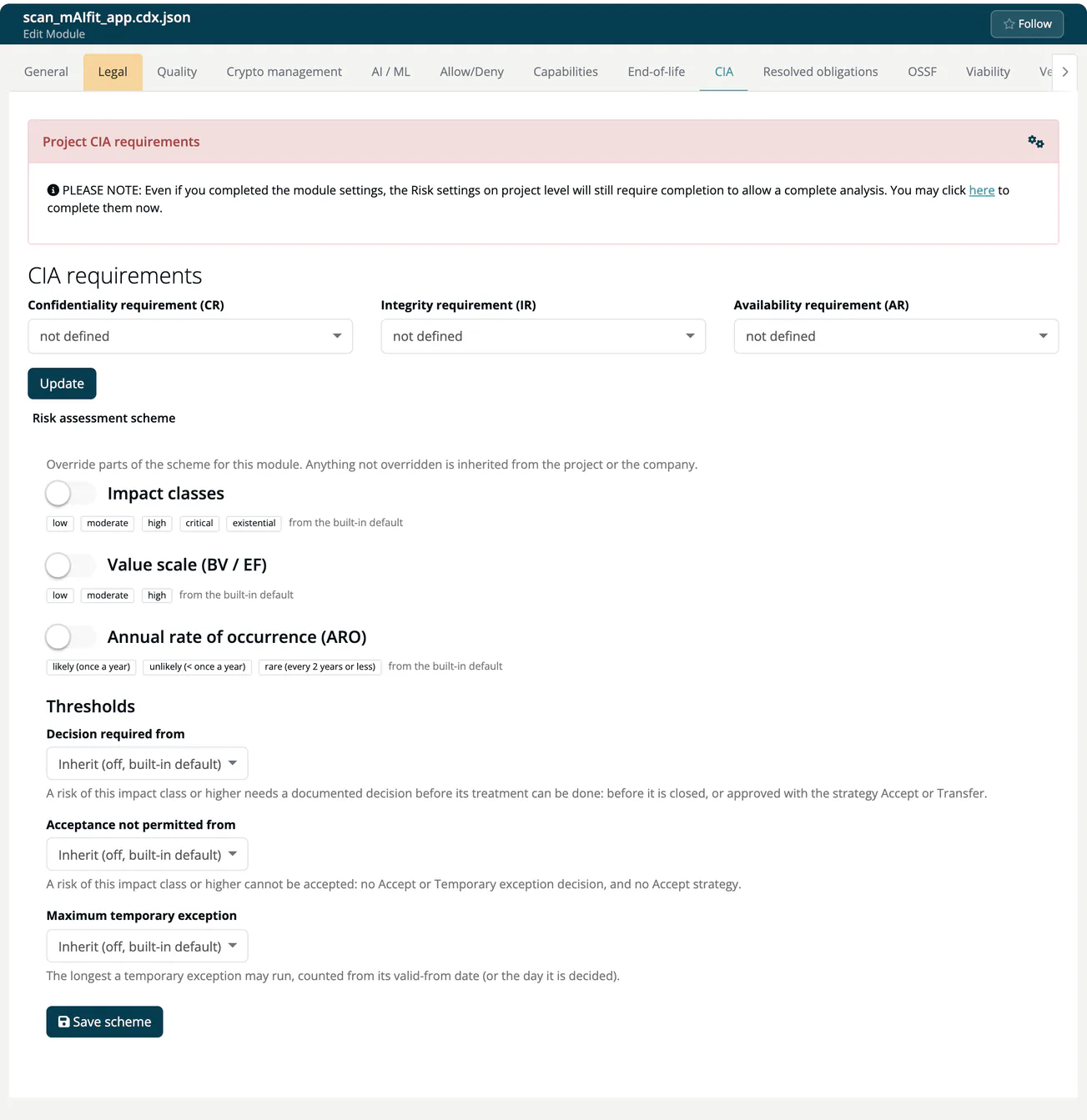
CIA stands for Confidentiality, Integrity and Availability. Here you state how much each of the three matters for this module. TrustSource uses the answers to put vulnerabilities in the context of your module, and to propose an impact class when you create a risk. The stricter value of module and project counts when it proposes an impact class for an automatically created risk; see Risks List.
Requirements
| Field | Options |
|---|---|
| Confidentiality requirement (CR) | not defined, low, medium, high |
| Integrity requirement (IR) | same |
| Availability requirement (AR) | same |
Click Update to save. A toast confirms CIA requirements changed!. A payment service handling card data would typically get CR high, IR high and AR medium.
Above the form, the panel Project CIA requirements shows the values of the project, with a link to its settings. If the project has none, a red note reminds you that the project still has to be completed for a full analysis.
Import CIA requirements from... copies the values of another module that has valid CIA settings.
Risk assessment scheme
With the risks license, the tab ends with the panel Risk assessment scheme. It lets this module deviate from the risk assessment scheme that risks are assessed on. Anything you do not override is inherited from the project or the company.
- Switch Override on for a list: Impact classes, Value scale (BV / EF) or Annual rate of occurrence (ARO). Each list takes at most 20 entries with a short value and a label. Impact classes also have a Rank that orders them from lowest to highest.
- Under Thresholds, set each of Decision required from, Acceptance not permitted from and Maximum temporary exception to Inherit, Off or Set.
- Click Save scheme. Remove override returns the module to the inherited scheme.
Without the right to edit, the panel shows who may change it.
Related